
Matched-account buyer comparison · prices and rules checked July 25, 2026
Apex Trader Funding vs My Funded Futures: Matched 50K EOD Scorecard
This compares Apex 50K EOD No Activation Fee with the My Funded Futures 50K Rapid evaluation. Both start with a $3,000 target and $2,000 EOD evaluation drawdown, but MFFU changes to intraday trailing drawdown after passing.
| Matched 50K decision point | Apex Trader Funding | My Funded Futures |
|---|---|---|
| Current price | $119 promotional · $1,190 reference for 50K EOD No Activation Fee | $157 one-time for 50K Rapid |
| Reset / activation | No reset on the new 30-day evaluation · $0 PA activation | $157 reset · $0 sim-funded activation |
| Profit target | $3,000 | $3,000 |
| Evaluation drawdown | $2,000 EOD trailing · $1,000 daily loss limit | $2,000 EOD trailing · no daily loss limit |
| Evaluation pace | At least 1 trading day · no consistency row on the matched evaluation | 2 minimum trading days · 50% consistency |
| Funded drawdown | EOD PA rules for the selected EOD product | $2,000 intraday trail from equity high-water mark; locks at $100 |
| Payout gate | 5 qualifying days · 50% consistency · safety net · $500 minimum · maximum 6 payouts | First eligible 24 hours after first funded trade only after $2,100 buffer · no funded consistency · $500 minimum · 90/10 |
| Best fit | Trader prioritizing lower price, one-day pass possibility, and EOD funded mechanics | Trader accepting higher fee and a two-day consistent evaluation for faster funded payout access, while comfortable with intraday trail and buffer |
Advanced way to shop this comparison
- Calculate cost to first eligible payout: include likely rebills or attempts, resets, activation, add-ons, and platform/data charges.
- Stress-test usable risk: subtract fees and slippage, model correlated positions, and test the exact EOD, static, or intraday-trailing definition.
- Replay payout eligibility: apply consistency, profitable or winning days, buffers, safety nets, minimums, caps, and account-lifecycle limits to your real P&L distribution.
- Verify operational trust: check the legal entity and rule-change history, get written approval for your strategy, and complete one small payout before scaling.
Official sources used for this snapshot
Promotions and terms change. Reconfirm the exact account, add-ons, platform, and jurisdiction at checkout.
Apex Trader Funding and My Funded Futures both target futures traders, but they suit different decision styles. Apex may be easier to understand if you want a defined end-of-day (EOD) evaluation path, clear account-size tables, and a payout structure that is documented in its help center. My Funded Futures may fit better if you want several plan styles, no activation fee, and a payout model that emphasizes speed and flexibility.
Last verified: June 5, 2026. This comparison focuses on Apex's EOD evaluation and Performance Account (PA) path and the My Funded Futures plan details covered in the official help-center pages cited in this draft. Other account types, promotions, legacy products, checkout prices, reset fees, platform fees, market-data costs, tax/payment details, and conduct rules may differ.
This comparison is based on official firm help-center pages available on June 5, 2026, plus the current Google page-one SERP for "apex trader funding vs my funded futures." Pricing, plan names, payout rules, and risk limits can change quickly, so confirm the live checkout and help-center pages before buying either evaluation.

Quick comparison for futures traders
| Decision point | Apex Trader Funding | My Funded Futures |
|---|---|---|
| Best fit | Traders who want a documented end-of-day evaluation and Performance Account path | Traders comparing plan flexibility, no activation fee, and faster payout options |
| Main drawdown framing in official docs reviewed | EOD drawdown for EOD accounts, calculated once daily and enforced in the next session | Intraday trailing drawdown for Rapid documentation, based on peak equity including unrealized gains |
| Evaluation consistency | Apex says consistency is not applied on its EOD evaluation account table | MFFU says Rapid, Flex, and Pro evaluations use a 50% consistency rule, with an exception for the Pro one-day pass |
| Payout framing | EOD PA docs describe up to weekly payouts, 5 qualifying trading days, a $500 minimum payout, a 50% PA consistency rule, and up to 6 payouts per PA | Payout docs describe daily Rapid payouts, plan-specific requirements, and many requests approved instantly, with manual review possibly taking 6 to 12 business hours on weekdays |
| Activation fee | Apex describes a one-time PA activation fee after passing an evaluation | MFFU says all plans have a $0 activation fee |
| Platform workflow | Apex documentation references Tradovate, Rithmic, WealthCharts, NinjaTrader, and TradingView access depending on account type | MFFU documentation references Tradovate and dxFeed monitoring for drawdown in the reviewed help article |
| Watch closely | Performance Account activation window, EOD threshold behavior, safety net, payout caps, and post-payout rules | Plan-specific payout cap, buffer, consistency, live-transition, and drawdown details |
The short answer
Choose Apex Trader Funding if you want the comparison to revolve around EOD account rules, a fixed account-size table, and a documented PA payout sequence. Its current EOD evaluation page lists account sizes from 25K to 150K, no evaluation consistency, no minimum trading days for passing, 30 calendar days of access, and a 7-day PA activation window after passing. Its EOD payout page then adds PA-specific rules such as 5 qualifying trading days, a $500 minimum payout, a safety net, and a 50% payout consistency requirement.
Choose My Funded Futures if you care more about plan variety, activation-fee friction, and payout cadence. The MFFU evaluation plan article says Starter, Core, and Scale are aimed at newer traders, while Expert and Pro target experienced traders who want fewer restrictions. Its activation-fee article states that all MFFU plans have a $0 activation fee, and its payout policy page says Rapid payouts can be requested daily once plan-specific requirements are met.
Neither firm is automatically better for every trader. The better choice depends on how you trade around drawdown, whether you prefer EOD or intraday risk measurement, how soon you want payout access, and how carefully you can follow the firm's current rulebook.
How the SERP frames this comparison
Google's current page-one results show comparison intent, not simple brand research. Searchers are trying to answer practical questions:
- Which futures prop firm is better for my trading style?
- Which one is easier to pass without hidden rule problems?
- Which one has the payout process I can actually manage?
- Are payout complaints or consistency rules a real risk?
- Does the firm support the platform workflow I already use?
The ranking pages generally include a direct verdict, a side-by-side table, pros and cons, payout discussion, trading-platform details, and FAQs. The gap is that many comparisons repeat broad claims from other review sites. A safer comparison is to separate official facts from decision guidance.
Apex Trader Funding overview
Apex Trader Funding is a futures prop evaluation company with multiple account and platform options. For this comparison, the cleanest official source set is its EOD Trailing Drawdown account documentation.
Apex's EOD Evaluation page says EOD evaluations use an end-of-day drawdown model. The drawdown is calculated once per trading day at market close and then enforced during the following session. The account table reviewed for this draft lists 25K, 50K, 100K, and 150K EOD evaluations, with profit targets, EOD max drawdown amounts, daily loss limits, max contracts, and a 30-day access period.
The same page says EOD evaluations have no minimum trading days and may be passed once the profit target is reached, as long as the trader respects the rules. It also says the trader has 7 calendar days to activate the corresponding PA after passing.
The EOD drawdown page is important because Apex's model is easy to misunderstand. It says the EOD threshold is calculated at market close, never moves downward, and is enforced in real time after it is established. If the threshold is touched, open positions are liquidated and the evaluation fails or the PA closes.
My Funded Futures overview
My Funded Futures is also a futures prop firm, but its public help center presents the offer more as a menu of plan types. Its evaluation-plan article separates Starter, Core, and Scale from Expert and Pro. Starter, Core, and Scale are described for traders who want a more guided path, while Expert and Pro are described for experienced traders seeking more flexibility.
The activation-fee article is a major differentiator. MFFU says all plans, regardless of account size, come with a $0 activation fee. That does not mean the evaluation is free, and it does not remove plan requirements. It means the firm's docs do not describe a separate activation payment after passing the initial evaluation.
MFFU's payout policy page emphasizes payout speed and plan-specific mechanics. It says most payout requests are approved instantly, with manual review potentially taking 6 to 12 business hours on weekdays. It also lists different payout structures for Rapid, Flex, and Pro plans.
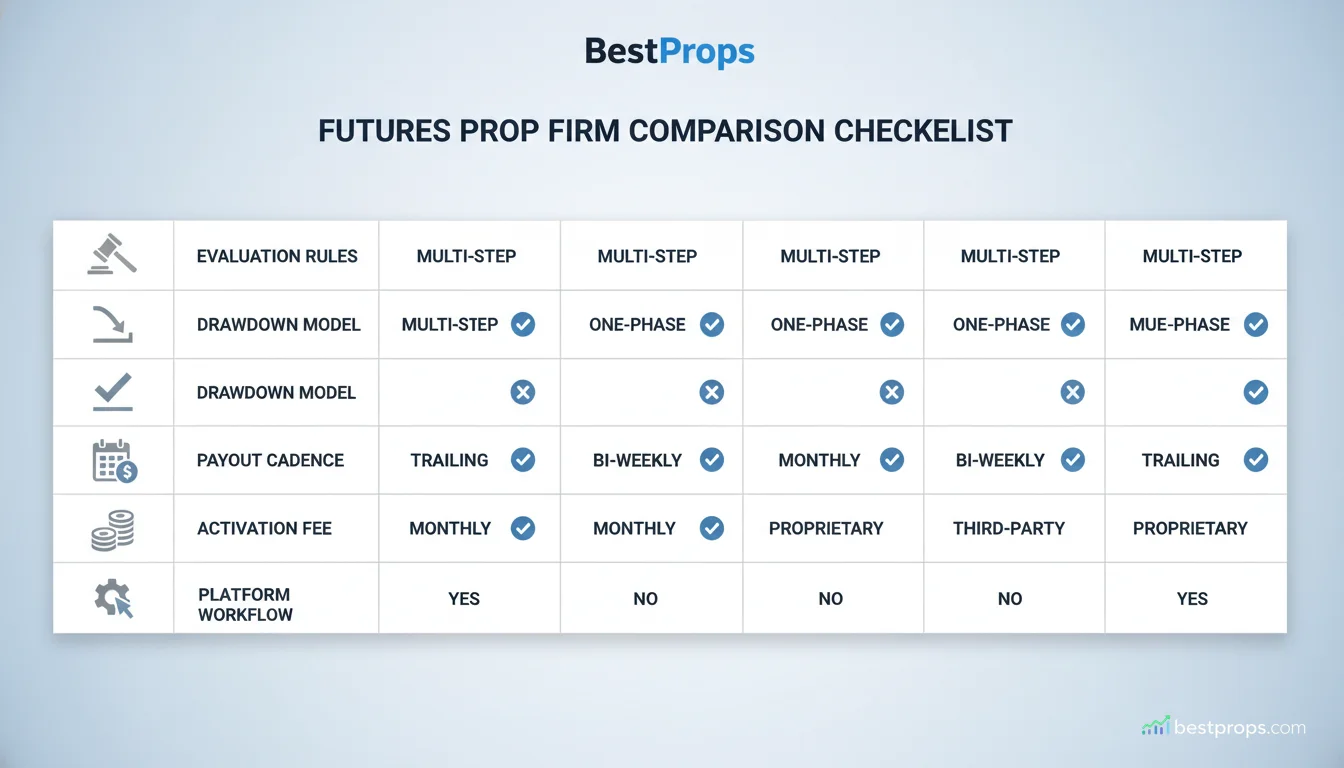
Evaluation rules compared
Apex's EOD evaluation structure is direct. You look at the account size, profit target, EOD max drawdown, daily loss limit, max contracts, and access period. The official EOD evaluation table says consistency and scaling are not applied during those evaluations. The page also states there is no minimum number of trading days required to pass.
MFFU's evaluation structure depends more on the plan. Its consistency-rule article says Rapid, Flex, and Pro evaluations use a 50% consistency rule, while the Pro one-day pass has no consistency rule. That rule means no single day's profit should exceed 50% of total evaluation profit. MFFU also says exceeding the target does not breach the account; the trader needs additional trading until the consistency threshold is satisfied.
That difference matters for trading style. If you are likely to hit most of the target in one strong session, Apex's current EOD evaluation documentation may feel more straightforward. If you prefer choosing among plan types and can manage a plan-specific consistency requirement, MFFU may offer more ways to match your experience level.
Drawdown model compared
Drawdown is one of the biggest practical differences between prop firms because it changes how much room your trades have before the account is breached.
Apex's EOD drawdown page says the EOD threshold is calculated once per day based on the closing balance. The threshold trails the highest achieved EOD balance and never moves downward. Even though the threshold is calculated after the close, Apex says it is enforced in real time during the next trading session once established.
MFFU's intraday drawdown article describes trailing drawdown as a dynamic loss limit that increases as account equity reaches new highs and does not decrease when losses occur. It says the funded-stage trailing drawdown is calculated intraday based on peak balance, including realized and unrealized gains, and that the threshold does not exceed the starting balance.
For a trader, the key is not which term sounds better. It is whether your strategy produces open-trade swings that can pressure an intraday trail. Scalpers and very short-term traders may care about real-time equity movement. Traders who plan around session closes may prefer an EOD framework, but they still need to respect intraday enforcement once the EOD threshold is active.
The drawdown risk traders often miss
Intraday trailing drawdown deserves extra attention because it can move while a trade is still open. If a trader has unrealized profit and then gives back part of that open gain, the trailing threshold may already have moved up. That can make the account feel tighter than a trader expected, especially for strategies that let winners breathe before exiting.
EOD drawdown is different, but it is not loose risk control. Apex's EOD documents say the threshold is calculated at market close and then enforced in real time during the next session. Once that threshold is established, touching it can still fail or close the account.
The practical question is whether your strategy creates large intraday equity peaks, holds through pullbacks, or relies on wide stops. If it does, compare the exact drawdown math before choosing either firm.
Payout rules compared
Apex's EOD payout page says EOD Performance Accounts can receive up to weekly payouts with a 100% payout split. It lists a minimum of 5 trading days meeting required minimum daily profit, a $500 minimum payout, a 50% consistency rule, and a maximum of 6 payouts per Performance Account. It also states that approved payouts are issued at a 100% payout split.
The same Apex payout page includes account-size-specific safety net and minimum-balance values. Those details should be verified directly before requesting a payout because they are operational requirements, not marketing copy.
MFFU's payout policy page is more plan-specific. Rapid is described with daily payout frequency, first payout eligibility 24 hours after first trade when buffer and minimum-profit requirements are met, no consistency rules, and a $500 minimum withdrawal after buffer. Flex and Pro have different payout requirements, profit splits, timing, and request limits.
This is where My Funded Futures can look more flexible, but also more complex. You need to know exactly which plan you are buying. A Rapid, Flex, Pro, Starter, Core, or Scale trader may not be operating under the same payout path.