
Key takeaways
Static drawdown accounts lock the loss limit at the starting balance and never move (FTMO 10%, FundedNext 10% for 2-step or 6% for 1-step), making them ideal for swing traders, news traders, and trend followers.
Read the full summary
Static drawdown accounts lock the loss limit at the starting balance and never move (FTMO 10%, FundedNext 10% for 2-step or 6% for 1-step), making them ideal for swing traders, news traders, and trend followers. EOD (End-of-Day) trailing drawdown accounts update the loss threshold only at market close, ignoring intraday peaks (Topstep uses this model, and it locks at the starting balance once you exceed initial balance + drawdown %). Intraday (real-time) trailing drawdown accounts adjust tick-by-tick on unrealized gains, making them punishing for all strategies except strict scalping (Apex uses this model with a safety net that locks at starting balance + $100). Static drawdowns provide the most forgiving environment for long-term growth; intraday trailing is the most restrictive and psychologically demanding.
Static Drawdown vs Trailing Drawdown for Prop Traders
For retail traders evaluating proprietary trading firms on BestProps.com, the profit target is often the main attraction. However, prop firm owners and professional traders understand that the drawdown rule is the true filter separating gamblers from consistent risk managers. Different firms employ radically different methods for measuring how much capital a trader is allowed to lose.
A trader applying a sound swing trading strategy to an intraday trailing drawdown account is almost mathematically guaranteed to fail, not due to poor market analysis, but due to a misalignment of strategy and risk rules. By contrast, that same strategy applied to a static drawdown account may yield consistent payouts. This guide provides a highly detailed, data-driven explanation of static versus trailing drawdowns, how major firms implement them, and how to optimize trading strategies for each model.
Introduction to Drawdown in Proprietary Trading
In the proprietary trading industry, “drawdown” does not merely refer to a temporary reduction in equity; it defines the absolute maximum loss limit a trader can incur before their account is breached, liquidated, or failed. Every prop firm enforces these risk limits to protect their capital from reckless trading behavior.
The primary confusion among retail traders arises from when and how these limits are calculated. Firms generally use two overarching categories of drawdown: static (fixed) and trailing (dynamic). However, the trailing category is further divided into End-of-Day (EOD) and Intraday (real-time) calculations. Understanding the mechanical differences between these models is essential for maintaining longevity in the prop trading space. For a broader overview, see our complete guide to drawdown rules explained.
What is Static Drawdown (Fixed Drawdown)?
A static drawdown, frequently referred to as a balance-based or fixed drawdown, is the most straightforward and trader-friendly risk management rule in the proprietary trading industry.
Under a static drawdown model, the maximum allowable loss limit is anchored exclusively to the initial starting balance of the account and never changes, regardless of how much profit the trader generates or loses. The floor is set on day one and remains in that exact location for the lifespan of the account.
Mechanical Function of Static Drawdown
Mechanically, a static drawdown provides an expanding buffer of protection as a trader becomes profitable. Because the floor does not follow the account balance upward, every dollar of profit earned increases the distance between the current equity and the breach level.
Real-World Example:
- Initial Balance: $100,000
- Static Drawdown Rule: 10% Maximum Loss ($10,000)
- Hard Breach Floor: $90,000 ($100,000 – $10,000)
If the trader begins trading and immediately takes a series of losses dropping the account to $92,000, they are still active, as they have not breached the $90,000 floor.
If the trader then goes on a winning streak and grows the account balance to $115,000, the maximum loss limit remains statically locked at $90,000. The trader now has a massive $25,000 buffer before they risk losing the account. This system heavily rewards consistent, long-term growth and mimics the risk parameters typically seen on professional institutional trading desks.
It is worth noting that some prop firms feature accounts where a trailing drawdown eventually “locks” at the starting balance, effectively transforming into a static drawdown for the remainder of the account’s life.
What is Trailing Drawdown?
A trailing drawdown is a dynamic loss threshold that adjusts based on the trading account’s peak performance. Instead of remaining fixed at the starting balance, the drawdown floor “trails” behind the highest balance or equity point achieved. Crucially, the limit only moves upward; it never moves downward, even if the account balance decreases due to a string of losses.
Proprietary trading firms utilize trailing drawdowns to enforce discipline, prevent traders from giving back massive windfalls, and protect the firm’s capital from severe drawdowns after a lucky winning streak. However, trailing drawdowns are highly sensitive to market mechanics and come in two distinct variations: End-of-Day (EOD) and Intraday (Real-Time).
End-of-Day EOD Trailing Drawdown
An End-of-Day (EOD) Trailing Drawdown updates the risk threshold only at the close of the trading session (e.g., midnight UTC or 5:00 PM EST, depending on the firm’s specific rules). The prop firm calculates the drawdown based strictly on the highest closed end-of-day balance.
Because EOD trailing drawdowns ignore intraday peaks and unrealized profits, they offer a forgiving environment during active trading sessions. A trader can enter a position, watch it float into heavy profit, endure a deep structural pullback, and eventually close the trade for a moderate gain, all without triggering an artificial breach of their drawdown limit.
Mechanics of EOD Trailing:
- Day 1 Start: $50,000 Balance. EOD Drawdown is $2,000. Floor is $48,000.
- Day 1 Intraday: The trader opens a position. Equity spikes to $52,000, but pulls back.
- Day 1 Close: The trader closes the day with a balance of $51,000.
- Day 2 Start: The new EOD peak is $51,000. The trailing floor moves up to $49,000 ($51,000 – $2,000). The intraday peak of $52,000 is ignored.
Intraday Real-Time Trailing Drawdown
The Intraday or Real-Time Trailing Drawdown is the strictest and most controversial risk management model in the proprietary trading sector. This threshold trails the account’s highest unrealized equity high, tick-by-tick, in real-time.
If an open position moves into profit, the drawdown limit moves up with it. If the market subsequently reverses and the profit evaporates, the drawdown limit does not reset; it remains anchored to that transient high-water mark. Consequently, a trader can breach their account while still in a winning trade or at breakeven, simply because the market pulled back naturally from a peak.
Mechanics of Intraday Trailing:
- Account Start: $50,000 Balance. Intraday Trailing Drawdown is $2,500. Floor is $47,500.
- The Trade: The trader enters a long position. The market rallies, pushing unrealized floating equity to $53,000.
- The Adjustment: In real-time, the firm’s software registers the $53,000 peak. The new hard breach floor instantly moves up to $50,500 ($53,000 – $2,500).
- The Reversal: The market experiences a normal structural pullback. The trader’s equity drops back to $50,400.
- The Result: Despite the account being fundamentally profitable and up $400 from its initial starting balance, the account is immediately liquidated and failed because the equity touched the new $50,500 trailing threshold.
Side-by-Side Comparison of Static vs Trailing Drawdown
Choosing between a prop firm with static drawdowns and one with trailing drawdowns drastically alters the necessary approach to risk management, position sizing, and trade psychology.
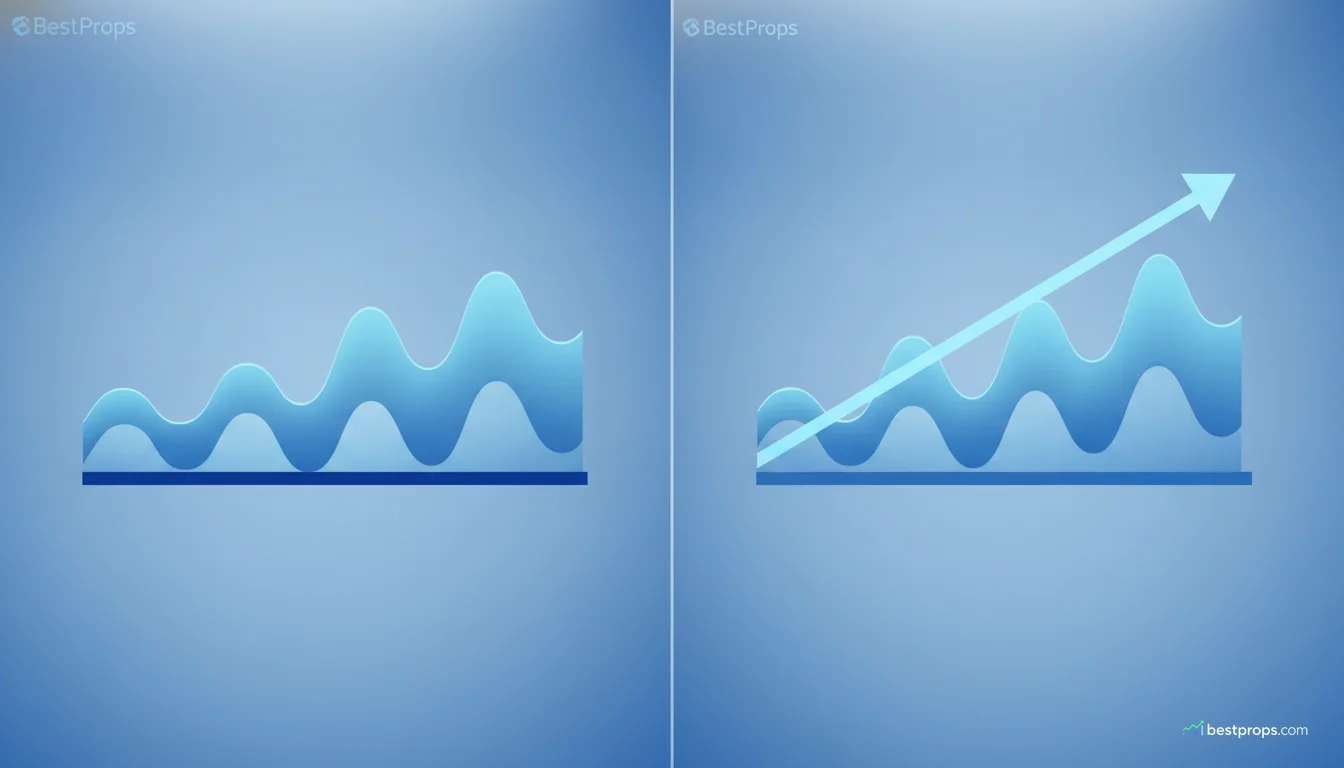
| Feature | Static (Fixed) Drawdown | End-of-Day (EOD) Trailing | Intraday (Real-Time) Trailing |
|---|---|---|---|
| Calculation Anchor | Initial Starting Balance | Highest Closed EOD Balance | Highest Unrealized Intraday Equity |
| Updates When? | Never; remains fixed | Once per day at market close | Continuously, tick-by-tick |
| Accounts for Floating Profit? | No | No | Yes |
| Punishes Normal Pullbacks? | No | No | Yes |
| Best Trading Styles | Swing, Trend, Scalping, News | Scalping, Day Trading, Trend | Strict Scalping only |
| Psychological Pressure | Low (allows buffer building) | Moderate (requires daily consistency) | Extremely High (requires constant monitoring) |
Forgiveness and Management Difficulty
Which is more forgiving? Static drawdown is unequivocally the most forgiving model. It allows traders to build equity “cushions” that can absorb significant losing streaks later in the account’s life. EOD trailing is a close second, as it mirrors authentic market environments where intraday price action involves volatile swings and pullbacks. As long as a trader finishes the session strong, their intraday floating metrics will not be weaponized against them.
Which is harder to manage, and why? Intraday trailing drawdowns are exceptionally difficult to manage. They force traders to micromanage their peak intraday balance and fundamentally alter how profitable trades are handled. A trader cannot let winners run freely because any severe retracement from the peak unrealized profit will trigger a breach. To survive an intraday trailing rule, traders are often forced into hyper-aggressive scalping, taking profits quickly before the market has a chance to pull back.
Drawdown Implementations by Major Prop Firms
Understanding theoretical models is only half the battle. Retail traders must dissect how top proprietary trading firms practically apply these rules to their evaluation and funded accounts. If you are specifically comparing the best futures prop firms, drawdown type should be the first filter you apply.
FTMO
FTMO, a giant in the Forex prop firm space, utilizes a highly transparent Static Maximum Loss model paired with a Maximum Daily Loss limit.
- Static Drawdown: FTMO enforces a static 10% Maximum Loss rule. On a $100,000 account, the equity can never drop below $90,000 for the duration of the account.
- Daily Loss Limit (DLL): They enforce a 5% Daily Loss Limit. Crucially, this limit is recalculated every night at midnight CE(S)T using the formula: Account balance at midnight – 5% of Initial Simulated Capital. It includes both closed results and floating P/L (equity).
Topstep
Topstep, a premier futures prop firm, is widely lauded for championing the End-of-Day (EOD) Trailing Drawdown (which they call the Maximum Loss Limit).
- EOD Trailing: Topstep calculates the trailing threshold solely from the account balance high at the end of the trading day. Intraday equity peaks are ignored, allowing trades to experience natural pullbacks.
- The Lock Mechanism: Once a Topstep funded trader achieves a balance that exceeds the initial balance by the drawdown amount (e.g., reaching $52,000 on a $50,000 account with a $2,000 limit), the trailing drawdown locks permanently at the initial balance ($50,000). It effectively converts into a static drawdown for the life of the account.
- Daily Loss Limit: Topstep uses a DLL, but hitting it typically results in a soft breach (a session lockout that disables trading until the next day) rather than an outright account failure.
Apex Trader Funding
Apex Trader Funding operates with an Intraday (Real-Time) Trailing Drawdown model, known as the Trailing Threshold, making it a high-risk, high-reward environment for specific trading styles.
- Real-Time Trailing: Apex’s threshold follows the highest achieved account balance in real-time, including all unrealized gains.
- Safety Net (Lock): In a Performance Account (funded stage), the intraday trailing stops once the threshold reaches the starting balance plus $100. For instance, on a $50,000 account with a $2,500 drawdown, the threshold trails until the peak equity reaches $52,600, at which point the floor locks at $50,100.
- Apex famously removes the Daily Loss Limit during evaluations, allowing absolute freedom in daily pacing, but the real-time trailing nature demands flawless execution.
FundedNext
FundedNext employs a hybrid model that heavily features Static Drawdowns, making it highly attractive for swing traders and those seeking straightforward rules.
- Maximum Loss Limit: FundedNext applies a static maximum overall loss limit based on the initial balance. For Stellar 2-Step accounts, this is 10% (e.g., $90,000 floor on a $100,000 account). For Stellar 1-Step, it is a 6% static loss.
- Daily Loss Limit: They implement a strict daily loss limit (typically 5% for 2-step models or 3% for 1-step models) that resets daily at midnight server time.
- Drawdown Adjustments: In specific “Instant” models, FundedNext may use trailing mechanisms that eventually lock to the initial balance upon reaching a profit target.
Which Drawdown Type is Better for Different Trading Styles?
A trader’s strategy must dictate their choice of prop firm, not the other way around. The type of drawdown a firm enforces will either severely inhibit or actively support specific market approaches.