Key takeaways
Prop firm drawdown rules define the account floor you cannot cross.
Read the full summary
Prop firm drawdown rules define the account floor you cannot cross. Check whether the limit is static or trailing, whether it follows balance or equity, when it updates, when it is enforced, and whether it locks. Topstep currently uses an end-of-day trailing Maximum Loss Limit that is monitored in real time. Tradeify uses end-of-day trailing maximum drawdown across its accounts and adds a lock on simulated funded accounts. FTMO 2-Step uses a static Maximum Loss equal to 10% of Initial Simulated Capital and measures the boundary with equity. BestProps checked the linked official rule pages on July 31, 2026 and did not test these programs first-hand.
How we researched this article
BestProps used document-based research from primary firm sources, checked August 1, 2026. The complete source list, scope, limitations, and commercial-state record appear near the end of this article.
Prop firm drawdown rules at a glance
A prop firm drawdown limit is the lowest permitted account value under a specific program rule. Touching or crossing that floor can pause trading, end an evaluation, or close an account, depending on the firm, product, and stage.
The account label is not the same as the amount available to lose. A $50,000 evaluation may have a much smaller permitted loss amount. The number that matters during a session is the current rule floor shown by the firm, not the account label by itself.
Read five fields before trading:
- Reference value such as initial capital, start-of-day balance, highest balance, or highest end-of-day balance.
- Loss amount stated as a dollar value or percentage.
- Tracked value such as balance, equity, net liquidation value, realized P/L, or realized plus unrealized P/L.
- Update time such as real time, market close, or a named timezone reset.
- Breach action such as a temporary session lock, evaluation failure, liquidation, or permanent account closure.
Daily loss rules and maximum drawdown rules are separate controls. Use the BestProps daily loss limit calculator for the daily boundary, then compare it with the account's maximum drawdown floor.
How prop firm drawdown limits move
Static prop firm drawdown
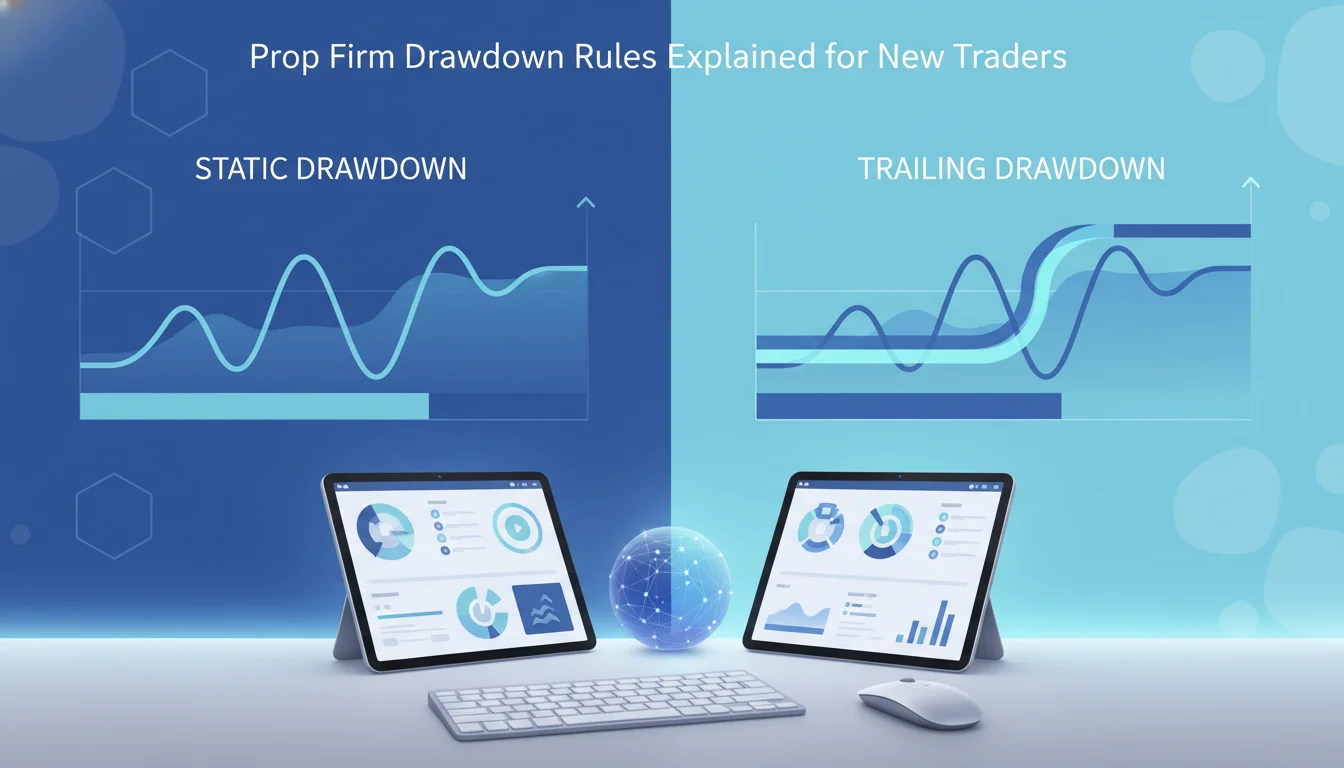
A static drawdown floor starts from a fixed reference value and does not rise when the account makes a new high. If an illustrative $100,000 account has a static $10,000 maximum loss amount, the floor is $90,000. A later profit does not change that floor unless the program rules say a withdrawal, reset, or account transition changes it.
Static does not mean balance-only. A firm can keep the floor fixed while monitoring equity, which includes open-position P/L. Treat the floor's movement and the value being monitored as two different questions.
Trailing prop firm drawdown
A trailing drawdown floor can move upward after the account reaches a new reference high. It normally does not move back down after a losing period. The exact reference high matters. Some programs use an end-of-day balance, while another rule could react to intraday equity.
Suppose an illustrative account starts at $50,000 with a $2,000 trailing amount. Its initial floor is $48,000. If the applicable reference value later reaches $50,500, the floor can rise to $48,500. A later drop in the account does not automatically move the floor back to $48,000.
Some trailing rules eventually lock at a fixed level. Check the required balance, the account stage, and whether the lock applies before or after a payout. Do not transfer one program's lock rule to another.
How prop firm drawdown values are measured
Balance-based prop firm drawdown
Balance usually reflects closed trading results. A balance-based rule may ignore an open trade until it is closed, but only if the official terms explicitly say so. The word balance in a dashboard label is not enough evidence on its own.
Equity-based prop firm drawdown
Equity usually combines balance with unrealized gains or losses and may also include commissions, swaps, or other adjustments. Under an equity-based rule, an open position can cross the floor before the trade closes.
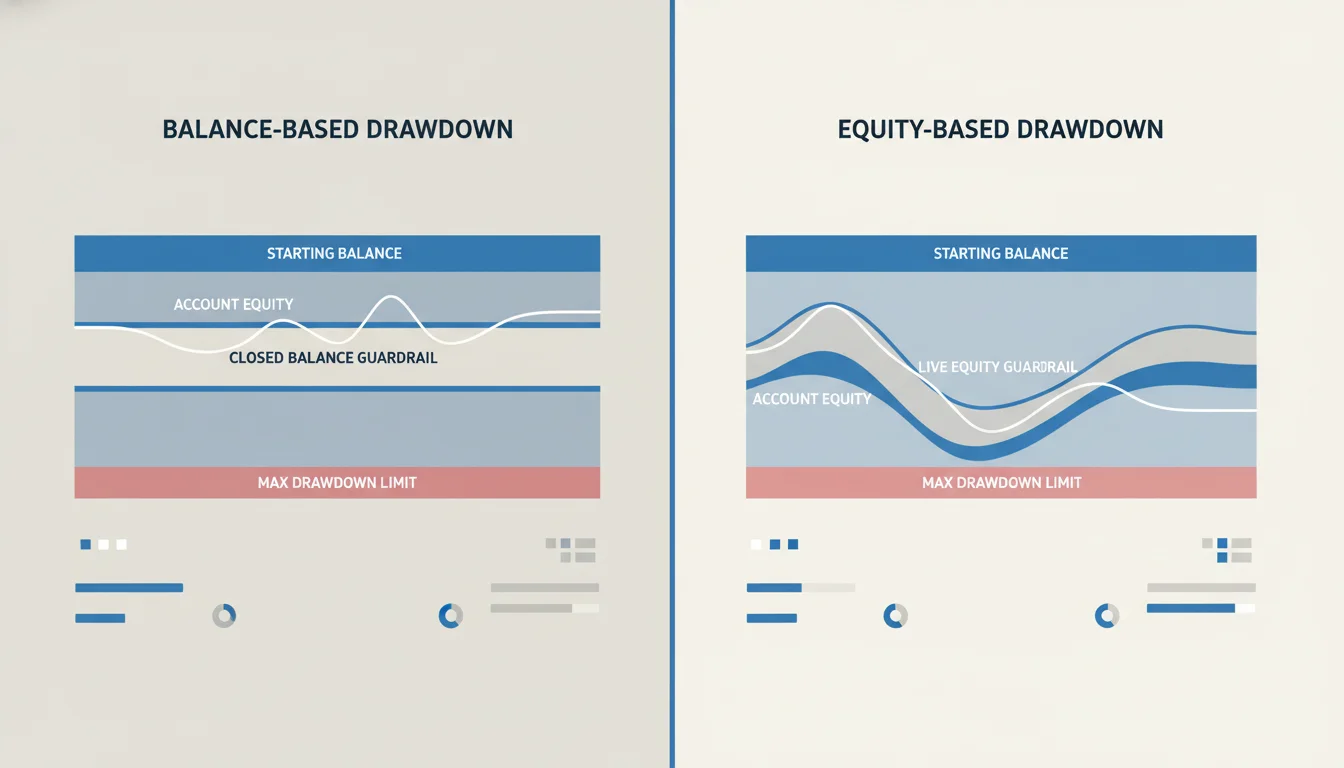
Look for the firm's exact formula. Terms such as net P/L, net liquidation value, and account equity are not always interchangeable across platforms or programs.
When prop firm drawdown rules update and apply
End-of-day trailing describes when the floor is recalculated. It does not necessarily mean the floor is ignored during the session. A firm can update a trailing floor after the close and still enforce the existing floor in real time.
That distinction creates two separate checks:
- Update check asks when a new high moves the floor.
- Enforcement check asks when current account value is compared with the floor.
If a dashboard displays a floor that refreshes once per day, keep the latest confirmed floor available during the next session. Do not assume an intraday recovery will undo a breach that was already triggered.
Prop firm drawdown examples checked in July 2026
These examples describe current official documents checked on July 31, 2026. They are not a universal ranking, and they do not prove execution quality or payout outcomes.
| Firm and program scope | Current drawdown method | What traders must verify |
|---|---|---|
| Topstep Trading Combine and Express Funded Account | The Maximum Loss Limit rises with end-of-day balance, never moves down, and locks at the program's stated level. Topstep monitors the active limit in real time using realized and unrealized P/L. | Confirm the current floor in the dashboard, the stage-specific starting value, and the effect of a payout or account transition. |
| Tradeify Growth, Select, and Lightning | Tradeify says all accounts use end-of-day trailing maximum drawdown. The floor follows the highest end-of-day balance and is enforced in real time. | Confirm the account type, current floor, breach action, and whether a simulated funded lock has occurred. |
| FTMO Challenge 2-Step, Verification, and subsequent FTMO Account | FTMO states that Maximum Loss is static at 10% of Initial Simulated Capital and is measured with equity, including open-position P/L, swaps, and commissions. | Confirm that the selected product is 2-Step because FTMO publishes different mechanics for 1-Step. |
The official documents are the controlling reference for each example:
How to calculate a prop firm drawdown floor
Use the firm's current formula, not a generic percentage copied from another account.
For a static rule:
floor = fixed reference value - maximum loss amount
For a trailing rule before any lock:
floor = applicable high-water mark - trailing amount
Then calculate the remaining room:
remaining room = current monitored value - current floor
If the rule monitors equity, use the equity figure defined by the firm. If it monitors balance, use the required balance figure. A positive result shows distance above the floor, not an amount that is safe or advisable to risk.
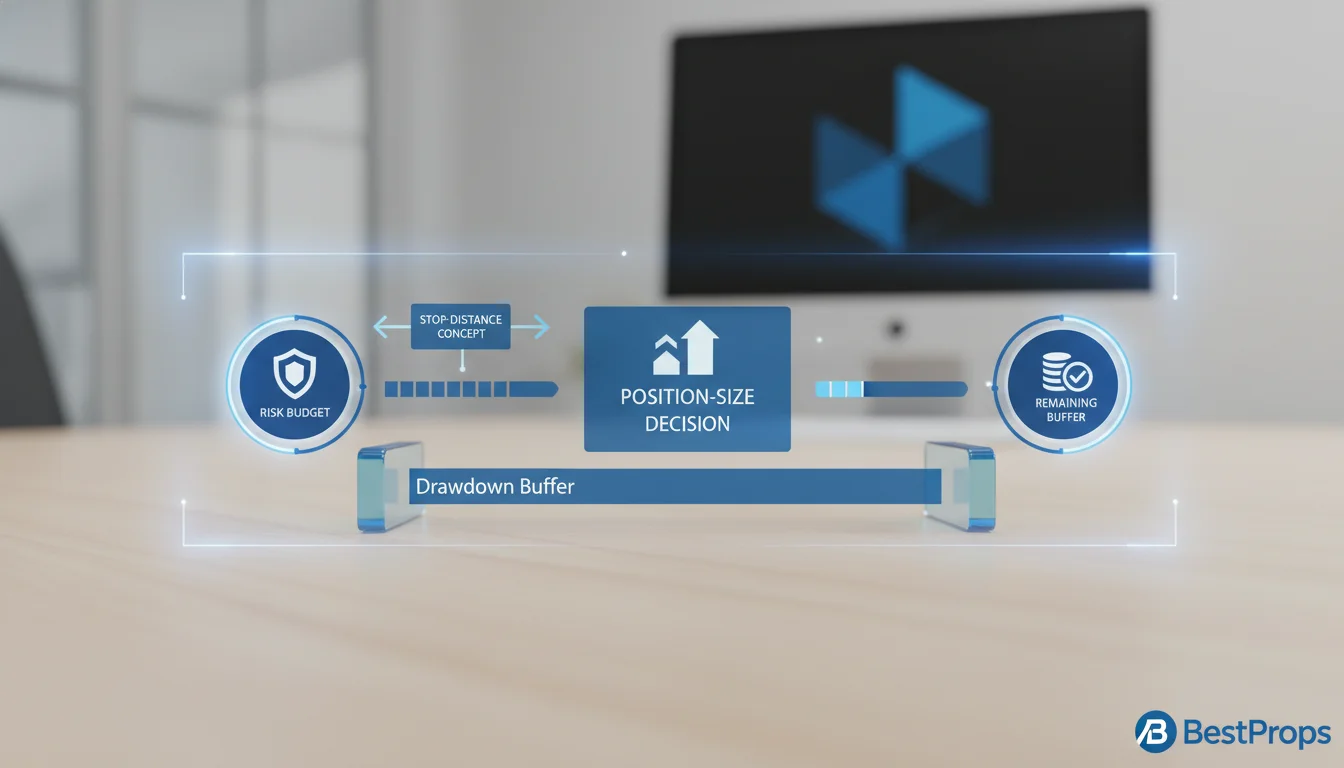
Leave room for commissions, fees, spread, slippage, and platform liquidation behavior when those items apply. BestProps does not prescribe a universal buffer percentage because execution and rule formulas differ.
How daily loss and maximum drawdown interact
A daily loss limit governs a session or named daily window. Maximum drawdown governs the larger account boundary. An account can remain above its maximum drawdown floor and still trigger a daily control. It can also remain inside a daily allowance while cumulative losses approach maximum drawdown.
Before each session, write down both current floors and the reset time for any daily rule. If a daily limit is a soft pause while maximum drawdown is a hard breach, treat those outcomes separately. The BestProps drawdown and daily-loss methodology explains how we separate program and stage when checking changing rules.
Prop firm drawdown checklist before buying
- Open the official rules for the exact product and account stage.
- Record the initial drawdown amount and current floor.
- Identify whether the rule is static, intraday trailing, or end-of-day trailing.
- Identify whether balance, equity, or another platform value is monitored.
- Confirm the timezone and update point.
- Confirm whether touching the floor counts as a breach.
- Check whether a payout, reset, or stage change alters the floor.
- Save the rule URL and date checked for your own records.
BestProps uses document-based research and does not claim first-hand testing on this page. If an official page conflicts with a dashboard or agreement, stop and ask the firm to clarify the rule in writing. You can report a BestProps page issue through our corrections policy.
Prop firm drawdown questions
Is prop firm drawdown based on balance or equity?
It depends on the program. A rule may track closed-trade balance, real-time equity, net P/L, or another platform value. The official formula should name the monitored value and any included commissions, swaps, or fees.
Does end-of-day drawdown protect intraday losses?
Not necessarily. End of day can describe when the floor moves, while the existing floor may still be enforced in real time. Topstep and Tradeify both publish this update-versus-enforcement distinction for the examples above.
Does a trailing drawdown ever stop moving?
Some programs use a lock. Topstep and Tradeify publish lock mechanics, but the trigger and fixed level depend on the program and stage. Confirm the current terms rather than assuming every trailing rule locks.
Is a daily loss limit the same as maximum drawdown?
No. A daily limit covers a session or daily window. Maximum drawdown covers the broader account loss boundary. A firm may use both, one, or neither for a specific product.
Can a payout change the drawdown floor?
It can. Payout effects are program-specific. Read the current payout and drawdown documents together before requesting funds, and compare the post-payout balance with the active floor.
As of July 31, 2026, BestProps has no affiliate or sponsor relationships. This dated fact does not establish whether an unrelated service or other commercial relationship exists. A future material connection must be based on a confirmed dated record and disclosed near the affected item. Read the BestProps Commercial Disclosure.